China–Japan Rivalry: Taiwan and the Future of Regional Security
 usanasfoundation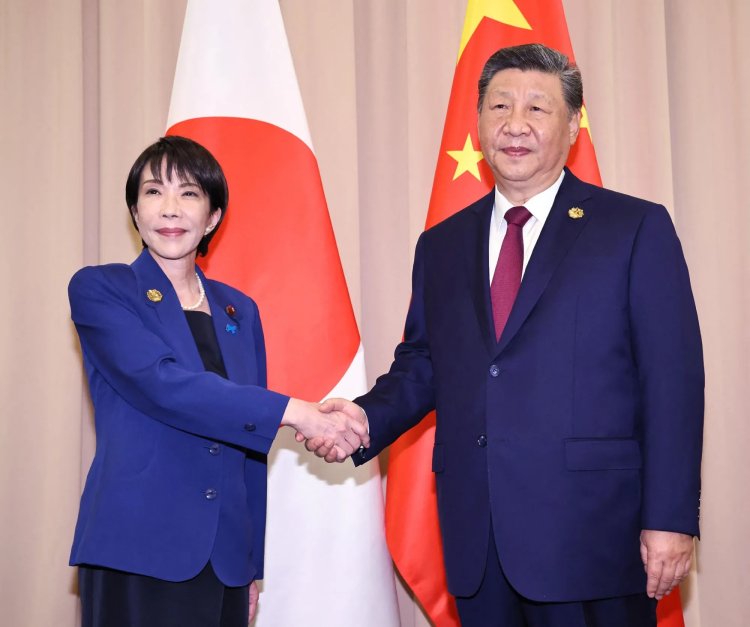
Analysis
By Nikita Anand
The relationship between the People's Republic of China (PRC) and Japan is fundamentally defined by a series of strategic contradictions. While their economies are profoundly interdependent, with each country relying heavily on the other for trade and supply chains, this economic reliance is overshadowed by deep-seated political distrust rooted in the historical trauma of the Sino-Japanese War. This difficult past continues to shape contemporary geopolitical friction, as evidenced by recent statements from Japanese officials. The recent escalation began when the Japanese Prime Minister, Sanae Takaichi, made a significant political shift by stating that a "war over Taiwan could threaten Japanese security."
This statement drew an immediate and harsh backlash from the PRC, which considers Taiwan to be an inalienable part of its territory. PM Takaichi further intensified the situation by characterizing the PRC's potential use of force and warships in the Taiwan region as a "direct threat to Japan's survival," a critical legal term in Japan’s post-2015 security framework that permits the deployment of its Self-Defense Forces for collective self-defense and military intervention.
In response, a significant period of diplomatic tension and reciprocal action ensued in November. The PRC responded strongly, not only through verbal condemnation but also with tangible economic and military actions aimed at punishing and pressuring Japan. These measures included issuing a travel advisory that severely affected Japan's tourism industry, banning Japanese seafood, increasing its military presence by deploying China Coast Guard vessels into the sensitive area around the Senkaku Islands, and conducting military drills near Japan. Additionally, Beijing expressed its criticism internationally by sending two letters to the United Nations condemning Japan's perceived alignment with Russia and North Korea. On Japan’s side, the new Prime Minister remained resolute, refusing to withdraw the controversial statements, thus deepening the diplomatic deadlock. Furthermore, the Japanese government announced a significant shift in its defence policy, pledging to increase its military spending to approximately 2% of its GDP by 2027. This plan involves a substantial investment of 5 trillion yen in long-range strike capabilities, including the purchase of US-made Tomahawk missiles and the accelerated development of its own indigenous arsenals. The overall dynamic is one where deep economic entanglement is being severely tested by profound political and security disagreements, creating a highly volatile situation in East Asia.
China-Taiwan Issue and Japan’s role in it
Under the Treaty of Shimonoseki, Taiwan was placed under the rule of Japan. After the surrender of Japan at the end of World War II in 1945, the Republic of China had its rule over Taiwan. But the situation changed in the year 1949 when the People’s Republic of China was established, after which the defeated government (ROC) relocated its seat to Taiwan. This led to Taiwan and China being ruled by different governments.
In 1972, Japan recognized the PRC as the sole government of China and respected China’s stance that Taiwan is a part of the PRC. In today’s time, it has been seen after the survey that there is a strong pro-Japan sentiment rising in Taiwan, where Taiwanese citizens frequently describe Japan as their "favorite country." This is seen as Japan successfully strengthening its influence with First Island China. All of this is seen as a great threat to PRC, largely because the First Island Chain is viewed by China as a U.S.-aligned barrier intended to contain its regional dominance and naval projection.
Role of the USA
The U.S.-Japan relationship has grown over the years, with China’s increasingly aggressive behavior being a prime reason for this expansion. In comparison to the 2010 and 2012 incidents, the reaction of the U.S to the whole situation has been very less so far, which might lead China to escalate further. The uncertainty with exists in the U.S policy might cause complexity in the strategic future implications of decisions to be more uncertain.
Since the start of the Russia-Ukraine war, Japan has shown its alignment towards Ukraine by providing it with 12 billion dollars. Japan’s new defense strategy, focusing on defense capabilities and deterrence, is seen to be strengthened by the US-Japan alliance, as evidently seen in recent joint military exercises held on Ishigaki Island. Beyond such matters, they have also focused on climate partnership, and the Chip 4 Alliance proposal and planned on improving cooperation in the commercial information and communication technology (ICT) sector.
One of the biggest point of tension between China and Japan exist in the territorial dispute over the Senkaku Islands. Since the Obama administration, these islands have been covered by the US-Japan Security Treaty. Japan is now seen as actively strengthening its longtime alliance with the United States in direct response to the perceived threats emanating from China.
Future Implications and the Indo-Pacific
The increasing tension between China and Japan has had an intense impact on the Indo-Pacific region. Japan’s decision to double its military expenditure with the intent of discouraging others from taking aggressive action. This will increase the chances of conflict, one related to Taiwan, that might occur, leading to regional instability. Japan has begun to plan to export military technology, such as the Type 03 medium-range surface-to-air missile, to other countries like the Philippines. And, China, seeing itself being contained along the First Island Chain, has started to expand its energy and resource interests toward Southeast Asia, specifically Myanmar, Laos, and Cambodia, to show itself as a geopolitical cushion against Japan-US security. The collaboration between Japan and Philippines was also seen growing as they share the same perception of China’s expansionist policy, which is a serious threat to regional security. The two countries have been building stronger ties for over two decades, with the partnership seeing significant progress over the last eight years, propelled by converging threat perceptions in an increasingly volatile Indo-Pacific. China has also been trying to weaponize trade by banning seafood, rare earth exports, which will not only damage its trust with Japan but also other nations in the world, prompting them to diversify their approach to exporting trade and reduce their dependency on China. Earlier, Japan adopted a strong security-focused foreign policy due to China's increasing influence in the Indo-Pacific and concerns over the long-term US security commitment. In December 2022 National Security Strategy (NSS) was designed to boost Japan's own military and also enhance the security capacity of like-minded regional partners. The main reason behind this was to decrease the influence of China in the maritime domain, and its policy of expansion operationalized through the Official Security Assistance (OSA) program.
The China-Japan relationship has reached its lowest point in history. China and Japan's strong friendship in the 1980s was established by agreements such as the 1972 Joint Statement, the 1978 Treaty of Peace and Friendship, and the 1998 Joint Declaration. Later, the core commitments present in the 1972 Communique, which involved issues related to Taiwan, were a major source of tensions between the two nations. The unhealed wounds of the past have continued to be an important source of conflict and mistrust between the nations, creating new tensions over issues like Taiwan and the Senkaku Islands. Unlike previous conflicts, looking at the current dynamics, it feels that de-escalation will be difficult and might not return to normalcy. Japan is redoubling its efforts to diversify its supply chain away from China by partnering with ASEAN countries and the United States. Also, Japan's recent approach of increasing its military expenditure is a shift from post-war pacifism managed under U.S security. Due to the deep-rooted conflicts happened in history with the recent strategic shifts, the future of the China-Japan relationship is uncertain, posing a risk to regional security.
Disclaimer: This paper is the author's individual scholastic contribution and does not necessarily reflect the organization's viewpoint.
Nikita Anand is currently working as an Assistant Manager at O.P. Jindal Global University. She has completed her Master’s in Diplomacy, Law, and Business, and her areas of interest lie in foreign policy.