Decoding Jamaat-e-Islami-Bangladesh's Borde Arc - Seats of Opposition Or Border Base
 usanasfoundation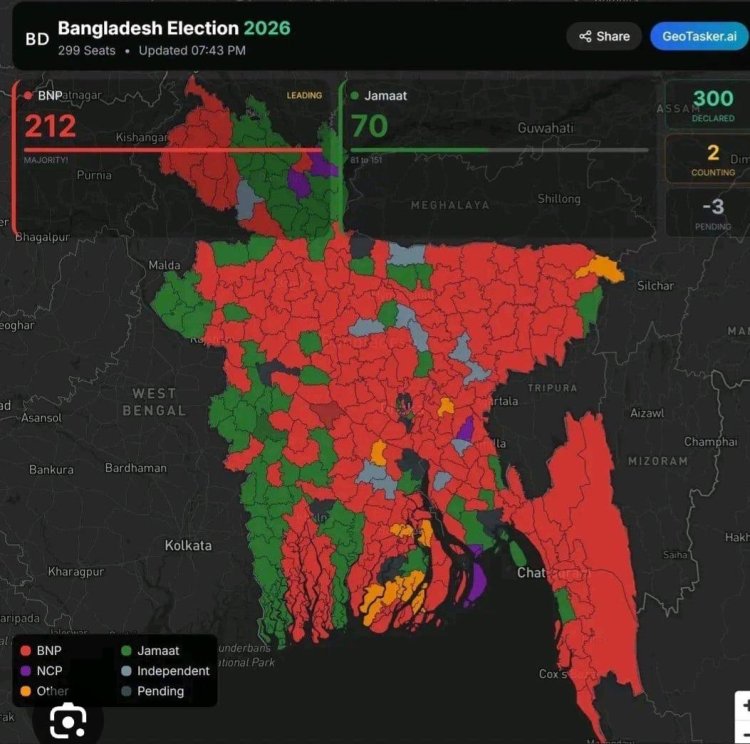
Analysis
By Lt Col Ujjual Abhishek Jha (Retd)
The political landscape of Bangladesh has endured a fundamental transformation following the uprising of 2024, leading to the fall of the Awami League government and the formation of an interim government. Interim government facilitated Islamist groups into mainstream, leading to the resurgence of Jamaat-e-Islami-Bangladesh (JeI-B), an organization that transitioned from a decade of state exclusion and marginalization to become the main opposition post elections. This resurgence is a revival of traditional Islamic politics by JeI-B to fill the vacuum of the previous secular order. The party's ability to maintain organizational coherence during years of repression, coupled with its strategic alliance-building and successful capture of the youth vote, has positioned it as a formidable political and ideological actor in the post-2024 era.
Performance in the 2026 General Election
The general elections held on February 12, 2026, represented a historic high for JeI-B. Contesting for the first time in 17 years, the party moved from its traditional status as a junior partner in a BNP-led alliance to becoming a main contender in the contest against BNP. While the BNP won a landslide victory with two-thirds of the seats, JeI-B secured the second-highest number of seats in the parliament, presenting its role as the official opposition.
Election Results Analysis (2026)
|
Party / Alliance |
Seats Won |
Significance |
|
Bangladesh Nationalist Party (BNP) |
212 |
Benefited from the absence of the Awami League and perceived governance experience. |
|
Jamaat-e-Islami Bangladesh (JeI-B) |
68 (Party) / 77 (Alliance) |
Highest seat count, border constituencies domination, and official opposition. |
|
National Citizen Party (NCP) |
Minor (06) |
Failed to convert the 2024 protest into a viable electoral base, joined the JeI alliance. |
The 2026 election results reveal a significant shift in regional vote shares. While the BNP maintained dominance in the central and northern divisions, Jamaat emerged as the dominant force in the districts bordering India. In Khulna division, JeI-B received a 48.26% vote share, surpassing the BNP’s 43.55%.
JeI-B Electoral Analysis: Indo-Bangladesh Border
|
Division |
Total Seats Won/ Available |
Primary Reasons |
Strategic Significance |
|
Khulna (South west) |
2527/ 59 |
Strong madrasa network since the 1980s, Hindu population (22.1%) polarization opportunity, Anti-India sentiment is high, |
Deep rural penetration shows JeI-B's grassroots strength, |
|
|
|
Historical grievances, an active Student wing in Jessore and weak Government delivery. JeI-B welfare network filled gap, and Rural constituencies embraced the conservative message |
Meherpur District Symbolic victory in Bangladesh's "birthplace of independence", Traditional smuggling routes through Sundarbans
|
|
Rajshahi (Western) |
6-7/ 30 |
Historically, Bangladesh's poorest regions. Limited Jamaat Success due to Stronger urban centers (Rajshahi city), Leftist political tradition from the pre-independence era. |
Selective success - strong in rural, weak in culturally mixed urban areas. Concern - Border constituencies controlled, opposite vulnerable Indian districts (Malda, Murshidabad).
|
|
Rangpur (Northern) |
1819/ 30 |
Rangpur experienced "Monga" (seasonal famine) - Government Neglect and failure to address chronic poverty, JeI-B's welfare networks, Higher Madrasa Density and Youth Unemployment |
Most Critical: Opposite Siliguri Corridor, Radicalisation threat, possibility of trans-terrorism network |
|
Other Border |
5-6/ 28 |
Limited Success, Major urban centre rejected JeI-B, Sufi Tradition (Shrine of Hazrat Shah Jalal), Educational Development, CHT Rohingya Factor didn't work |
Scattered presence |
Available Data based on multiple open sources
Border Dominance: Analyzing the Satkhira-Dinajpur Axis
Jamaat-e-Islami achieved striking dominance in the 2026 Bangladesh elections along the Indo-Bangladesh border (nearing total dominance along the Indian border), controlling a continuous 800-km arc from Satkhira through Jessore, Dinajpur, and Rangpur. This contiguous zone spans Khulna, Rajshahi, and Rangpur divisions, primarily rural border constituencies. The major factors for JeIB border dominance are: -
Organizational Infrastructure - Crackdown on JeI-B’s Madrasa network from 2009-2024, forced members to go underground, but networks were maintained. The network was rapidly reactivated from 2024.
Specific Incidents Exploited to Raise Anti-India Sentiment – The incidents of Felani Khatun (2011), Phulbari Shootings (2006), Padua Village Incident (2001), and Routine Harassment were part of JeI-B's campaign strategy to raise strong anti-India sentiments. It was further promoted by providing financial assistance to families of victims, wide media coverage, creating martyr narratives, social media campaigns with victim photos and Friday sermons in mosques mentioning victims & framed as a religious duty to resist.
Systematic Narrative: India as Oppressor – Systematic set-up of Anti-India narrative to present the need for Bangladesh to seek autonomy from India's regional dominance and align with China, Pakistan, Turkey and the Gulf states.
Locally Driven Issues - Historical migration grievances, economic neglect (poverty, floods, "Monga" famines), JeI-B's welfare amenities filling government gaps and higher Hindu populations (10-22%) drove identity polarization. Jamaat systematically focused on communal mobilization and targeted vulnerable demographics. Urban areas resisted due to economic independence, heterogeneity and better services.
Security Concerns
Soft Infiltration - Social/Religious Institutions: Soft Infiltration implied that no armed militants crossing but ideological influence and cultural penetration. The methods are Marriage Networks, Religious Teachers, Charitable Work, Media/ Social-Media and Economic Networks.
Transnational Linkages and ISI Nexus - The resurgence of JeI-B coincided with a strategic shift in Bangladesh's foreign policy orientation under the interim government. A significant warming of relations with Pakistan by the resumption of direct air connectivity and high-level visits by Pakistani military and intelligence officials has facilitated the reactivation of transnational Islamist networks that were suppressed during the previous decade.
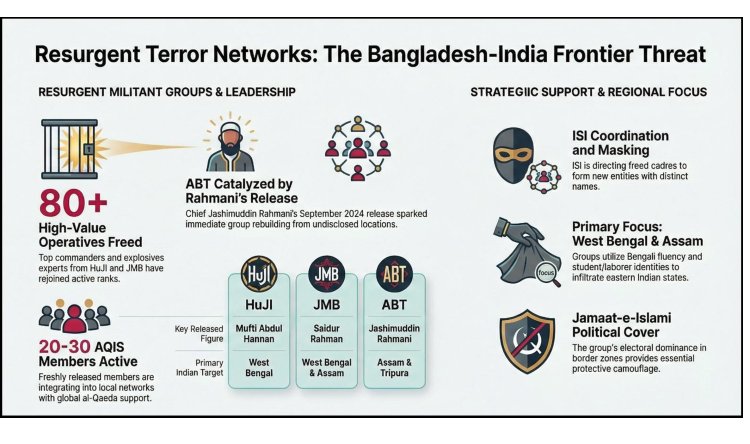
Terrorist Group Threat - This is the most disturbing aspect of the JeI-B victory along the borders in the backdrop of amnesties, resulting in the return of commanders and experienced operatives to active status. Key organizations, including Harkat-ul-Jihad Islami (HuJI), Jamaat-ul-Mujahideen
Bangladesh (JMB), Ansarullah Bangla Team (ABT), and Al-Qaeda in the Indian Subcontinent
(AQIS), reportedly attempting systemic reorganization. Leveraging the political infrastructure of JeI-B and possible support of ISI, these groups will likely target states of West Bengal, Assam and Tripura. The convergence of seasoned leadership, international funding and linguistic cohesion across the border creates a major security concern. An assessment of these groups is shown in the table below.
|
Group |
Likely Targets States |
Recruitment Base |
Key Strengths |
|
HuJI |
West Bengal |
Jamaat electoral base |
Experienced, funding, Ataur Rahman and Mufti Abdul Hannan freed. |
|
JMB |
West Bengal, Assam |
Cross-border modules, Border voters |
Saidur Rahman, JMB's chief, and Mizanur Rahman, an explosive expert, were released. Existing though weakened network along the border. |
|
ABT |
Assam, Tripura, West Bengal |
Labourers, students |
Sleeper cell, Chief Jashimuddin Rahmani, released in September 2024, Bengali fluency, significant presence in Assam, evidenced by over 60 arrests between 2015 and 2024. |
|
AQIS |
General |
Online platforms |
Global training & planning |
The resurgence of Jamaat-e-Islami has created a "three-front" concern for India, increased involvement of China and Pakistan, release of terrorists and the possibility of reorganising and re-entry of ISI into Bangladesh's domestic affairs with the availability of JeI-B electoral base along the Indo-Bangladesh border. The resurgence of JeI-B shows its resilient infrastructure, which allows it to survive political repression, and the 2026 election results ratified the same.
For India, the transition represents the emergence of a permissive environment for transnational jihadist actors. Addressing these challenges will require a holistic approach that combines an assertive diplomatic stance that leverages economic interdependencies and prevents the establishment of anti-India militant bases with a systematic and planned counter-narrative.
Disclaimer: This paper is the author's individual scholastic contribution and does not necessarily reflect the organization's viewpoint.
Lt Col Ujjual Abhishek Jha (Retd) is an Intelligence veteran and Geopolitical Risk Analyst with over two decades of experience in Military Intelligence and National Security operations across sensitive theatres of the North East, Punjab and Gujarat borders.