Hamas Beyond West Asia: Why Its Growing Links in Pakistan and Bangladesh Matter for India
 usanasfoundation
Analysis
By Ruchika Sharma
The Hamas-led attack on October 7 highlighted a critical development in the global terror landscape: the growing ties between West and South Asian terror groups. The developments that occurred post-October 7 indicated that Hamas is no longer confined to West Asia; it is expanding its influence in Pakistan, Bangladesh and even its virtual footprints are visible in India. The growing nexus between terrorist groups in South and West Asia poses a serious challenge to counter-terrorism efforts. Though these connections are not new, they are now getting structured and coordinated, extending across operational activities, ideological exchange, and information networks. The first part examines the series of developments that have taken place in Pakistan and Bangladesh, as well as pro-Hamas sympathies in Afghanistan. The second part will focus on India and Malaysia, which is emerging as another critical front warranting closer attention, given the rising levels of Hamas sympathy at the political and public levels.
Pakistan as a Safe Haven for Hamas:
Pakistan’s link with Hamas post-October 7 is not new; they are part of a longer trajectory that has steadily deepened over time. In 2009, during Palestinian Foreign Minister Mahmoud Zahar's visit to Pakistan, Islamabad pledged $3 million in aid to the Palestinian Authority and signalled support for Hamas. Its long-standing support for the Palestinian cause has increasingly served as a proxy for backing Hamas and the atrocities committed during the October 7 attack. During the Labbaik Al-Quds Million March organised by Jamaat‑e‑Islami in Peshawar, Hamas leader Ismail Haniyeh’s recorded speech was played, in which he appreciated Pakistan’s support for Hamas. Haniyeh also urged former Prime Minister Imran Khan to take practical steps in support of the Palestinian cause. His speech highlighted Hamas's nexus moving to another level when he suggested that Pakistan was equally involved in Hamas’s victory.
In the post-October 7, 2023, period, Hamas leaders have paid frequent visits to Pakistan, openly addressed rallies and forged alliances with religious political parties and local terror groups to gather support and legitimacy for their extremist ideology and terrorist activities.
Key Hamas leaders, including Dr. Naji Zaheer, special representative to Hamas leader Khaled Meshaal, have shared the stage with US‑designated terror organisations such as Lashkar‑e‑Taiba (LeT). In an undated video, Dr. Naji Zaheer attended an event in Gujranwala, in Pakistan’s Punjab province, organised by Pakistan Markazi Muslim League (PMML), widely known as LeT’s political front, where he met LeT commander Rashid Ali Sandhu. Sandhu is a close aide to Saifullah Khalid Kasuri, a US-designated global terrorist and mastermind behind the April 2025 Pahalgam attack in India’s Union Territory of Jammu and Kashmir. The ties between Hamas and Lashkar-e-Taiba, both US-designated terrorist organizations, are highly visible after the October 7 attack. In August 2024, Saifullah Khalid was seen with Hamas polit-bureau chief Khaled Meshaal and Dr. Naji Zaheer in a meeting held in Doha, Qatar. This meeting is not an isolated development; in Pakistan-occupied Kashmir (POK), Hamas leaders Dr. Naji Zaheer and Dr. Khaled Qaddoumi (Hamas representative in Tehran, Iran) shared the stage with both Lashkar-e-Taiba (LeT) and Jaish-e-Mohammed (JeM) top commanders on February 5, 2025, observed as Kashmir Solidarity Day–a propaganda exercise to promote an anti-India agenda. This was reportedly the first-ever visit of Hamas to POK.
To evoke the sense of collective identity, speeches during these events are filled with rhetoric, embedded with victimhood narratives, glorifying jihad and framing martyrdom as a heroic path to their liberation. Moreover, false parallels are increasingly drawn between Kashmir and Palestine for ideological mobilization, describing both as “twin struggles for Muslims’’.
Political and Diplomatic Support in Pakistan:
Hamas has also found space within Pakistan’s diplomatic circles and political landscape. In 2019, the Pakistani ambassador, Najib Durrani, welcomed a Hamas delegation and reaffirmed Pakistan’s principled stance on the Palestinian cause. Hamas also continues to enjoy the support of Pakistan’s largest religious political party, Jamiat Ulema-e-Islam (F) and its chief, Maulana Fazl-ur-Rehman, who is at the forefront in organizing anti-Israel rallies in its nationwide conference series ‘’Toofan-e-Aqsa’’ and ‘’Shaheed-e-Islam Conference’’, which was launched after the October 7 attack, also dubbed as Toofan-e-Aqsa/Operation Al-Aqsa Flood by Hamas. Notably, the liberation of Al-Aqsa, the first qibla of Muslims, is used as a powerful narrative to bind the global Muslim ummah. Dr Naji Zaheer, while calling for the liberation of Al-Aqsa, strategically embedded the Palestinian struggle to evoke a sense of continuity. The JUI-F chief has not only hosted Dr. Naji Zaheer but also met with other key Hamas leaders, including Dr. Khaled Meshaal, Ismail Haniyeh (deceased) and Dr. Khaled Qaddoumi.
Building on these developments, Pakistan’s largest religious political party, Jamaat‑e‑Islami, allegedly a South Asian cousin of the Muslim Brotherhood with deep inroads in politics, even demanded the opening of an office of Hamas in Pakistan. Jamaat-e-Islami’s ideology, which promotes the aim of bringing the world under Islamic rule, makes these interactions particularly concerning. In 2006, Jamaat-e-Islami reportedly transferred $100,000 to Hamas.
Under the watchful eyes of Pakistan’s army and state, Hamas, a terror organization designated by dozens of countries, including the US, has also made significant visits to the Karachi Press Club, the Islamabad Bar Association, and various religious and even educational institutions.
Recently, a video shared by a Pakistani user in March 2026 purportedly shows Hamas leader Dr. Naji Zaheer greeting a gathering during Eid‑ul‑Fitr. Notably, he is seen in a long white beard, a visible change as compared to his earlier videos.
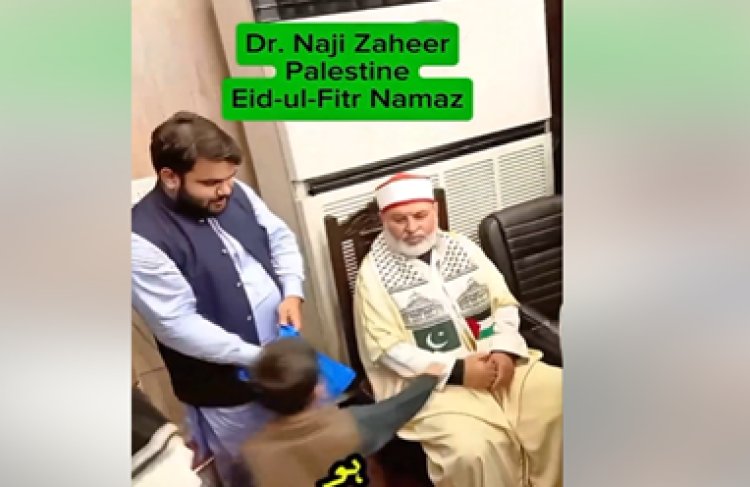
Source: Social media; A purported video claiming Hamas leader Dr. Naji Zaheer at a gathering
This purported footage can be part of a broader pattern of ‘’shadow militancy’’ and visual propaganda usually employed by terror groups. The images and clones of leaders are a part of the propaganda campaign to project continuity, resilience and symbolic presence, regardless of their actual whereabouts.
Bangladesh
Developments in Bangladesh are equally alarming. On October 7, 2024, a religious event drew Hamas leaders Dr. Khaled Qaddoumi and Khaled Meshaal, along with JUI-F chief Maulana Fazl-ur Rehman, organized by Al Makazul Islami, an Islamist organisation in Bangladesh, close to India’s northeastern region. An intelligence report revealed that the aim of the meeting, coordinated by Pakistan’s Inter-Services Intelligence in October 2024, was directed towards propagating radical Islamist ideology to inspire terror activities in India’s northeastern states.
Prior to this, in May 2024, Bangladesh Chhatra League activists organized a rally at Dhaka University, in which anti-Israel slogans were reportedly raised.
In the same year, following the killing of senior Hamas political leader Ismail Haniyeh (July 31) and Hamas’ political bureau head Yahya al-Sinwar (October 16), Bangladesh’s Jamaat-e-Islami Ameer Dr. Shafiqur Rahman expressed grief over their deaths. An August 2024 report noted that thousands of people gathered for the slain Hamas leader Haniyeh’s funeral in Doha, Qatar. The attendees in the funeral prayers were from various countries, including Bangladesh, India, and Sudan.
In October 2024, the Islamic Chhatra Shibir (the student wing of Jamaat-e-Islami Bangladesh) held a funeral for slain Hamas leader Yahya al-Sinwar. The funeral prayers were also organized in the National Mosque Baitul Mukarram in Dhaka, where thousands of students reportedly attended the prayers. According to the Iran Press Agency, Hamas enjoys notable popularity among students and ordinary people in Bangladesh.
These events reflect that organizing funeral prayers is a part of Hamas’s key strategies not only to mobilize masses for solidarity and ideological purposes but also to evoke the sense of collective identity that reinforces its portrayal as a defender of Al-Aqsa Mosque. After the death of Yahya al-Sinwar, Hamas called for funeral prayers to be held in mosques and Islamic centers worldwide, urging supporters to hold "anger marches" to condemn Israeli actions in Gaza and to defend Palestine, Al-Aqsa Mosque, and Al-Quds.
Similar gatherings took place in Afghanistan, where several people gathered at Kabul’s historic Eidgah Mosque to offer prayers for Haniyeh and express solidarity with the people of Gaza. This shows that Hamas strategically converts mourning into mobilization and symbolism, which could serve as an instrument of long‑term radicalization.
Apart from this, during several pro-Palestine rallies, anti-Israel and anti-India slogans have been raised. The rising pro-Hamas sentiments in Bangladesh could potentially serve as a recruitment and radicalization ground close to India’s, where rising pro-Hamas sentiment and jihadist networks can easily spill across porous borders.
Disclaimer: This paper is the author's individual scholastic contribution and does not necessarily reflect the organization's viewpoint.