Shadows Over the Brahmaputra: Dissecting the United Liberation Front of Asom (Independent) Trajectory
 usanasfoundation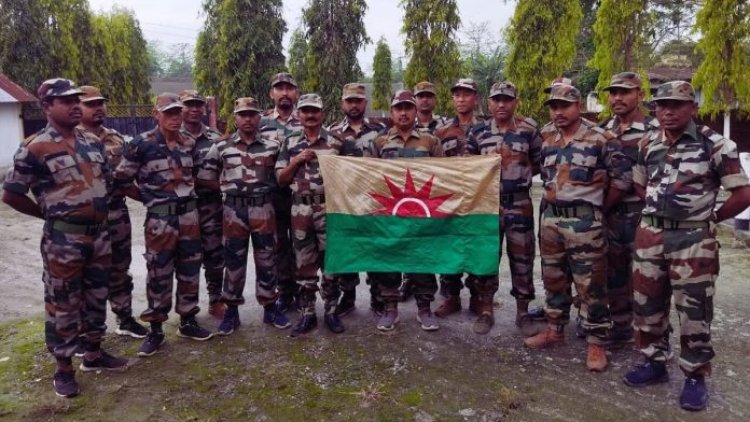
Occasional Paper
By Lt Col Ujjual Abhishek Jha (Retd)
Abbreviations:
ULFA-United Liberation Front of Asom
ULFA (I)-United Liberation Front of Asom (Independent)
SoO- Suspension of Operations
MoS - Memorandum of Settlement
NSAZ-Naga Self-Administered Zone
IED- Improvised Explosive Device
IMB - Indo-Myanmar border
NSCN (K-YA)-National Socialist Council of Nagaland (Khaplang-Yung Aung)
RPF/PLA- Revolutionary Peoples Front/People's Liberation Army (Manipur)
OGW-Over-Ground Workers
SWOT- Strength, Weakness, Opportunities, Threat
The United Liberation Front of Asom (Independent) ULFA (I) is the only major active insurgent group in Assam. The split in the United Liberation Front of Asom (ULFA) in February 2011 led to the formation of two splinter groups, namely ULFA and ULFA (I). In 2011, ULFA (also referred to as the pro-talk faction), led by Arbinda Rajkhowa, entered into an unconditional Suspension of Operations (SoO) agreement with the Government of India. On 29 December 2023, the SoO was concluded through a Tripartite Memorandum of Settlement (MoS), signed by the ULFA (pro-talk faction), the Government of India, and the Government of Assam. The 2023 accord addressed political representation, a pledged ₹1.5 lakh crore development package, cultural and land safeguards, and the rehabilitation, disarmament, and disbandment of the signatory faction.
However, Paresh Baruah, self-styled Chairman and Commander-in-Chief of ULFA (I), did not support the peace process and continued to pursue his core demand for the ‘Sovereignty of Assam,' terming it as non-negotiable. He continued his armed struggle under the banner of ULFA (I), which carries out its activities from its mobile camps in the Naga Self-Administered Zone (NSAZ), Sagaing Region, Myanmar, with its leader Paresh Baruah, reportedly based in Yunnan Province of China.
Brief Background
ULFA was founded on 7 April 1979 at Rang Ghar in Sivasagar, with key individuals being Bhimakanta Buragohain, Rajiv Rajkonwar (alias Arabinda Rajkhowa), Golap Baruah (alias Anup Chetia), Pradip Gogoi, and Paresh Baruah, in the political ferment of the Assam Movement (1979-1985). Unlike other Northeast insurgent groups, which were primarily organised along tribal lines, there were three core ideologies behind the formation of ULFA: the colonial theory, Swadhin Asom, and an organizational model ULFA's cadre base was regional & linguistic, with recruitment extending across communities that spoke Assamese, giving it a larger state-wide presence. The organisation took up arms with the declared aim of establishing a “Sovereign Socialist Assam” organised in the 1980s and 1990s, supported by training camps in Bangladesh, Bhutan, and Myanmar at various time periods. Sustained counter-insurgency operations by the Security Forces progressively degraded the original organisational base of ULFA and forced the repeated relocation of its camps and leadership. The arrest of several top leaders, including chairman Arabinda Rajkhowa in 2009, catalysed an internal split. In 2011, the Rajkhowa-led faction entered an unconditional SoO agreement with the Government of India. Thus, ULFA (I) remains the only Assam-based insurgent group that has not joined the peace process and continues to engage in low-intensity armed activity, extortion, and recruitment, thereby representing a lower level of combat potential but retaining symbolic significance. The ban on ULFA (I) was extended for a period of five years by the Ministry of Home Affairs, Government of India, with effect from 27 November 2024.
The continuing relevance of ULFA (I) analysis lies not in its residual combat strength, which is now assessed to be approximately 200 armed cadres (as per informal interactions with surrendered and mainstreamed cadres), but in three lasting factors. Firstly, its demonstrated capacity to carry out asymmetric but visible violent acts such as low-intensity IED blasts, extortion, kidnapping, and targeted killings. Secondly, it has a deep-rooted support framework in Myanmar (earlier in Bangladesh too), along with reports of covert support from Pakistan and shelter to top leaders in China. Thirdly, it has symbolic status as the last unresolved insurgency linked with the Assam Movement.
Building on the above, the paper analyses the status of ULFA (I) and follows a three-part strategic framework. First, it tabulates the Framework of Survival of ULFA (I), analyses the Residual Capability, discusses the SWOT analysis, and explores the Way Ahead Scenarios.
Framework of Survival
The survival of ULFA/ ULFA (I) for more than four decades, despite the downfall of its original support base and the mainstreaming of its parent organisation (ULFA), primarily stands on four mutually sustaining pillars, i.e. trans-national sanctuary, organisational structure, resource base and a persistent ideological narrative. The details of these four mutually sustaining pillars are mentioned in the table below.
|
Pillars |
Key Aspects |
Evolving Dynamics & Trajectory |
|
Trans-National Sanctuary |
• Trans-national Bases in NSAZ, Sagaing Region, Myanmar. Past usage of Bhutan and Bangladesh. • Terrain – Rugged, Remote and forested, along the Indo-Myanmar border (IMB), enabling mobile camps and infiltration. • Alliances with Myanmar-based Naga insurgent groups - NSAZ, primarily controlled by various Naga insurgent groups and the ULFA (I)-NSCN (K-YA) nexus, facilitate shelter, survival and safety of ULFA (I). |
• Reported Drone Strike - On 13 July 2025, a drone strike on a ULFA (I) camp in Myanmar killed many cadres, including a few senior leaders.
• Impact – The incident led to relocation/ abandoning of camps of ULFA (I) and created similar fear for Naga insurgent groups, leading to support. |
|
Organisational Structure |
• Command Structure: Central Council, the historical pivot of organisation, with political and military wings • Support Networks – Extensive network of OGWs to support logistics, safe-houses, movement and communications. • Core Leadership - Led by Paresh Baruah with distributed & localised cells. |
• Restructuring (Dec 2025): All existing councils dissolved, and a new Central Committee of 24 members was formed under Paresh Baruah as President. • Internal Division - Paresh Baruah has not visited Myanmar camps for more than a decade, and routine activities are controlled by Michael Deka Phukan. |
|
Resource Base |
• Finances - Illicit financing and extortion activities. • Arms Supply Chains - Dependence on China-Myanmar border markets (Wa controlled areas). • Peripheral Support - Diaspora channels (limited but exist) and cooperation with regional groups such as NSCN (K-YA) & RPF/ PLA of Manipur. |
• Disruption in financial networks - Assam Police unearthing larger funding channels, including Uttar Pradesh (May 2026). ● Seizures & Arrests in 2026 (as available in open domain): Total Arrests - 35. Arms Seized: AK-56 rifles - 02, Ammunition - 172 rounds, Hand Grenade - 02. OGW – 02. Surrenders – 03.
|
|
Persistent Ideological Narrative |
• Ethno-Nationalism: Deep-rooted in Assamese identity and the Assam Movement against illegal immigration & economic exploitation. • Narratives based on Grievances - Focused on demographic changes, land and cultural erosion. • Targets for Recruitment: Exploits indigenous and ethnic sentiment; targets unemployed youths. |
• Ideological Firmness - Paresh Baruah maintains a non-negotiable demand for ‘Sovereignty’ of Assam as a precondition for dialogue. • Political Stalemate: Blockade for peace talks. |
Residual Capability Analysis
The available open-source data, interactions with local residents and interactions with mainstreamed surrendered cadres indicate a quantifiable decline in the outfit’s strength and activities. However, the outfit retains disruptive capabilities and sporadic acts of violence. A tabulated analysis of its residual combat capability is given below.
|
Aspects |
Residual Potential |
Capability Analysis |
|
Armed Capability |
Low to Moderate |
Limited combat potential, restricted to low-intensity symbiotic operations, strength approximately 200. |
|
Sphere of Influence |
Low to Moderate |
Restricted to sporadic violent actions and extortion activities, with no ability to hold ground or sustain prolonged operations. Operational cooperation with NSCN (K-YA) & RPF/ PLA continues. |
|
Recruitment & Support Base |
Low to Moderate |
The recruitment is on the decline, though local sympathiser and OGW networks remain. |
|
External Support Architecture |
Low |
Camps in Myanmar relocated/ dislodged, sustained pressure from SF operations on the Indian side and alliances in Myanmar have fragmented due to ongoing conflict in Myanmar and external support, as in the 1990s and the 2000s, has gradually eroded. |
ULFA (I) is in a state of disarray, with fragmented command and logistics networks and low morale of cadres in camps in Myanmar. The status of the outfit is on the decline, but it still retains capacity for extortion, low-intensity targeting, and occasional large-scale attempts, such as the alleged conspiracy to execute multiple blasts at 24 claimed locations, of which 19 were shared with local media, in Assam on Independence Day in August 2024.
SWOT Analysis
Strengths
ULFA (I) continues to draw its core strength from a lasting ideological commitment to Assamese sovereignty. This ideological base is supported by decades of operational experience in underground tradecraft, distributed cell structures, and cross-border movements. Beyond its traditional strongholds, the group retains active OGW networks and extortion channels, as well as expanded (inter-state) financial networks. Furthermore, ULFA (I) has access to arms markets along the China-Myanmar border. Most importantly, its position as the last unreconciled Assam-based insurgent group provides it with symbolic weightage, allowing it to sustain political and psychological relevance in the region.
Weaknesses
Although it retains symbolic importance, the combat potential of ULFA (I) has declined significantly, with an estimated strength of around 200 cadres and an increasing attrition rate. This decline is compounded by the surrender/arrests of leaders responsible for key functions such as Arunodoy Dahotia and Rupom Asom, the physical disconnect between the top leader, Paresh Baruah, and the camps in Myanmar, and increasing pressure arising from the situation in Myanmar, which has lowered the morale of cadres. This has led to a break in ideology and weakening internal discipline among cadres. The relocation/dislodgement of camps in Myanmar has affected the outfit adversely in terms of morale, safety, logistics, and coordination with alliance partners. Moreover, the mainstreaming of ULFA, post MoS in December 2023, has reduced the attraction of ULFA (I) and resulted in a substantial decline in the recruitment of fresh cadres.
Opportunities for the State
In the present context, the state possesses considerable leverage to further contribute to the structural decline of ULFA (I). Leveraging the surrender flow requires broadening and actively promoting targeted amnesty and socio-economic support initiatives, including the delivery of the ₹1.5 lakh crore development package to address socio-economic grievances. In ULFA (I), the internal fragmentation, restructuring, and surrender/arrest of high-profile leaders offer intelligence, information, and psychology-based operations opportunities to the SF. Most importantly, sustained counter-insurgency operations with Myanmar-based actors could serve as a primary mechanism to permanently dismantle the cross-border logistics base of ULFA (I).
Threats to Security
The volatile external dynamics (the armed internal conflict in Myanmar and the transitional government in Bangladesh) pose severe risks to the stability of the Northeast Region and also pave an opportunity for ULFA (I) to renew its old sanctuaries. On the tactical side, operational cooperation and coordination between ULFA (I), NSCN (K-YA) and RPF/PLA (Manipur) magnifies the risk of coordinated insurgent attacks. For Assam, persistent extortion and intimidation tactics pose a threat to the state’s development agenda.
Way Ahead Scenarios
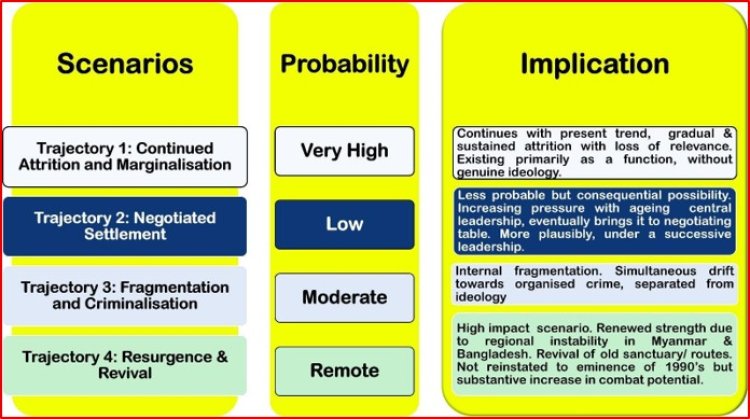
The long-term dominance of ULFA (I) has significantly waned; however, its eventual disposition depends on a complex interplay of internal leadership dynamics, regional geopolitical dynamics, and the state’s counterinsurgency posture. Analyzing historical trends, contemporary realities, and longstanding interplay, it outlines four plausible trajectories for ULFA (I), evaluating each scenario based on its probability and implications. These scenarios and trajectories are shown below.
Conclusion
ULFA (I) symbolizes an insurgency that is organizationally degraded but remains persistent in existence, four decades after its formation and the mainstreaming of the disbanded faction through the December 2023 MoS. Driven by declining cadre strength, internal disillusionment, and the displacement of its camps in Myanmar, the faction survives on residual extortion, cross-border ties, and an enduring core ideology. Although the short-term outlook points toward a low-intensity stalemate drifting gradually toward state integration, the risk of resurgence remains plausible if regional shifts in Myanmar, Bangladesh, or other external actors provide fresh lifelines. Ultimately, while the decline of ULFA (I) is genuine, it remains potentially reversible. Fully resolving Assam’s last active insurgency demands sustained military, financial, diplomatic, and developmental pressure, combined with continued openness to political engagement.
Disclaimer: This paper is the author's individual scholastic contribution and does not necessarily reflect the organization's viewpoint.
Lt Col Ujjual Abhishek Jha (Retd) is an Intelligence veteran and Geopolitical Risk Analyst with over two decades of experience in Military Intelligence and National Security operations across sensitive theatres of the North East, Punjab and Gujarat borders. He is a Fellow at Usanas Foundation.