The Future of NATO Amid Fractures and A Rising China
 usanasfoundation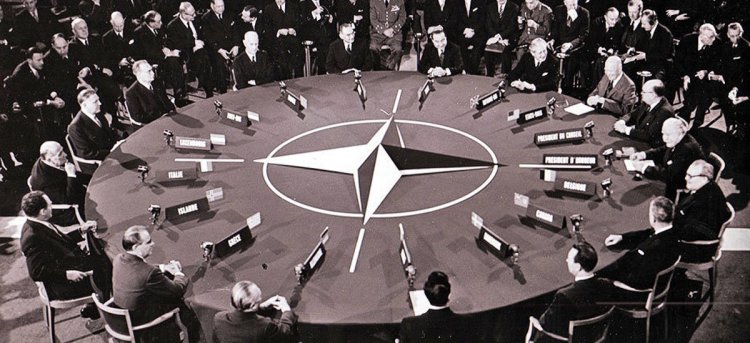
Analysis
By Sierra Knoch
Trump recently announced the likely removal of US troops from Germany in light of a lacking European response to the US position in the Iran conflict. This sparked renewed debate and fears around the future of NATO and a potential US exit.
There are multiple fractures within NATO that are co-occurring. Trump has demanded an increase in spending contributions from NATO states and has asked Europe to increase burden-sharing for European security. Eastern states have responded to this call. Economic and defence influence within Europe will continue to shift eastward, especially towards Poland, Romania, and the Baltic states. Eastern NATO states are now among the alliance’s biggest military spenders relative to GDP, but due to their scale, ultimately cannot salvage NATO alone. Germany and France still possess Europe’s largest industrial defense base and remain indispensable to large-scale NATO rearmament due to their financing and manufacturing capacity, as well as French nuclear deterrence. This highlights the divide within NATO as Western European nations don’t seem to take the alliance as seriously as Eastern states. Ultimately, without commitments from these larger Western European states, the US feels its resources could be better spent elsewhere. Sec. Rubio recently stated, “If the main reason why the US is in NATO is the ability to have forces deployed in Europe that we could project to other contingencies, and now that’s no longer the case…that’s a problem, and it has to be examined.”
But there is another divide inside NATO that is even more important. Washington and Trump increasingly view CCP-style Communism and Islamic extremism that aims to dominate and remake Western society as the highest priority threat to the alliance and Western civilization. While European powers still view Russia as the most severe threat they are facing and ignore the decline created by unchecked mass immigration, strangulating economic policy, and rampant social spending. While it’s true that Russia is known to meddle in European affairs to change eastern European borders, they have depleted their resources and, after losing alliances and proxies around the world thanks to President Trump’s strong actions, do not wield the same influence they once did. Highlighting this divide on how the two sides view these competing threats, Sec Rubio stated at the Munich Security Conference in February, “The United States has no interest in being polite and orderly caretakers of the West's managed decline." This signaled that the US is not planning to step in and save Europe from its own self-inflicted security woes.
Washington is ultimately looking for European powers to unify and increase commitments to defense cooperation, rearmament, and not only NATO funding commitments, but also individual national defense industry spending. While the ultimate solution would be for Europe to reclaim its sovereignty from the Islamic-Marxist alliance that is currently dominating its left-wing political decision makers, many analysts believe that Europe will remain politically gridlocked and unable to address these threats emanating from China and Islamic extremist groups. According to European policy insiders, European leaders remain more interested in maintaining their levers of power and catering to their Islamic voter base as well as their Chinese business partners than in taking principled steps to rebuild European security.
Another possibility relevant for India is the emergence of non-alliance alliances with states that may hold deep reservations about one another, but who ultimately share the same threats and ambitions for economic and industrial capacity. While NATO remains preoccupied with its short-term views on Russia as its biggest threat, India remains clear-eyed towards the threat of a rising China, as well as the ongoing threat from Islamic terrorism. Additionally, a postwar Russia with close ties to India and a potential trade relationship with the US, as well as aligned views on the threat of terrorism, could be pulled away from China to create a counterbalance to Chinese expansionism, in the absence of NATO’s initiative on the world stage. While Russian territorial ambition towards Europe is real, NATO fails to recognize the declining nature of this threat due to Russia’s military failures during the war, and the fact that Putin is advancing in age. Russia will emerge from the Ukraine war a shell of the global power it once was, but its manufacturing base, energy resources, and military knowledge gained through partnership with China could still make it a relevant player on the global stage. With the combined resources of India and the US to act as a uniting force for the non-aligned, Russia should recognize the value in distancing itself from China in a post-war scenario. For India, the threat is neither theoretical nor distant. The Himalayan border clashes, expanding Chinese naval presence in the Indian Ocean, infrastructure projects under the Belt and Road Initiative, and Beijing’s growing influence in South Asia have reinforced India’s perception that China seeks long-term regional dominance. As a result, Indian strategic thinking tends to be less ideological and more geopolitical than many Western approaches. New Delhi’s objective is not necessarily confrontation but preventing strategic encirclement and preserving a multipolar Asia. This is where India’s approach diverges from portions of NATO. While NATO remains heavily centered on European territorial security and the immediate Russia-Ukraine conflict, India increasingly sees China as the primary long-term challenge to global stability. From New Delhi’s perspective, Russia — though weakened by war and sanctions — may ultimately prove less threatening than an economically and technologically dominant China. While this outcome would not represent a formal alliance between the three powers, geopolitical history shows that major powers often realign when confronted with a larger common concern or in this case, concerns of an expansionist China and Islamic extremism.
Disclaimer: This paper is the author's individual scholastic contribution and does not necessarily reflect the organization's viewpoint.
Sierra Knoch is an Adjunct Professor at Point Loma University