Hamas’ Expanding Footprints in South and Southeast Asia: Why This Is Alarming for India
 usanasfoundation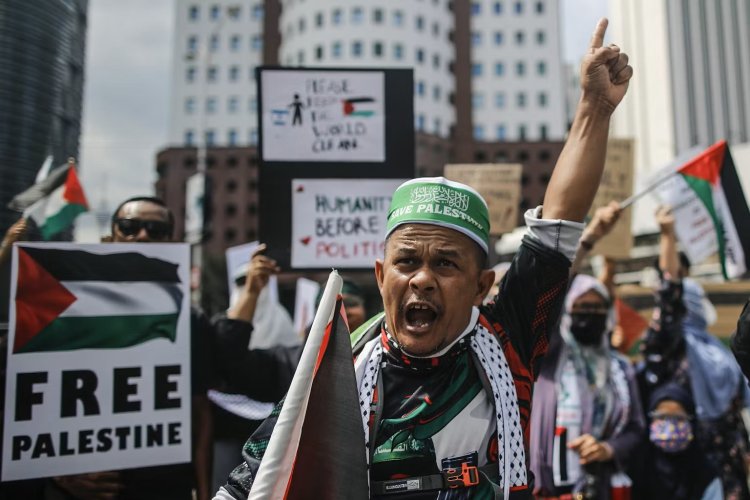
Analysis
By Ruchika Sharma
The developments post-October 7 attack highlight Hamas's expansion of its influence beyond West Asia. Building on the developments in Part 1, which focused on Hamas's growing ties in Pakistan and rising pro-Hamas sympathies in Bangladesh as well as Afghanistan, this article focuses on Hamas's virtual footprints in India and its strongholds in Southeast Asia. Though Malaysia's support for the Palestine cause and Hamas is not new, recent developments suggest that it is emerging as a critical front that warrants closer attention. A latest report highlighting the resettlement of 15 Palestinian prisoners to Malaysia heightens the need for India to carefully examine the ongoing developments and integrate them into India's counter-terrorism framework.
Hamas Footprints in India
For India, the challenge is no longer limited to its neighbourhood. Hamas-aligned narratives and sympathies are visible within India as well. During pro-Palestine rallies in Kerala, posters featuring slain Hamas leaders such as Yahya al-Sinwar, the chief architect of the October 7 attack, and Ismail Haniyeh have been prominently featured. Even a poster of slain Hezbollah leader Hassan Nasrallah, was seen during a cultural festival in Palakkad, Kerala.
In October 2023, Dr. Khaled Meshaal addressed a virtual rally organized by The Youth Solidarity Movement in Kerala, which functions as a youth wing of Jamaat-e-Islami Hind. During the rally, ‘’Uproot bulldozer Hindutva and Apartheid Zionism’’ slogans were reportedly raised, and attempts were made to draw parallels between both the ideologies. On October 26, 2023, the biggest-ever Palestine solidarity march was organized in Kerala, reported Al-Jazeera. Over 200,000 people rallied after the Indian Union Muslim League called for protests to oppose the war in Gaza.
After the killing of Hamas leader Yahya al-Sinwar in October 2024 by the Israeli forces, a funeral prayer was organized in Kerala by the Students Islamic Organisation, which is a youth wing of Jamaat-e-Islami. Samad Kunnakav, assistant secretary of Jamaat-e-Islami Kerala, reportedly led the prayers. In another separate development, the Students Islamic Organization mourned the death of Hamas leader Ismail Haniyeh. They also released a poster marking Haniyeh’s death anniversary, framing Hamas leaders as a martyr figure.
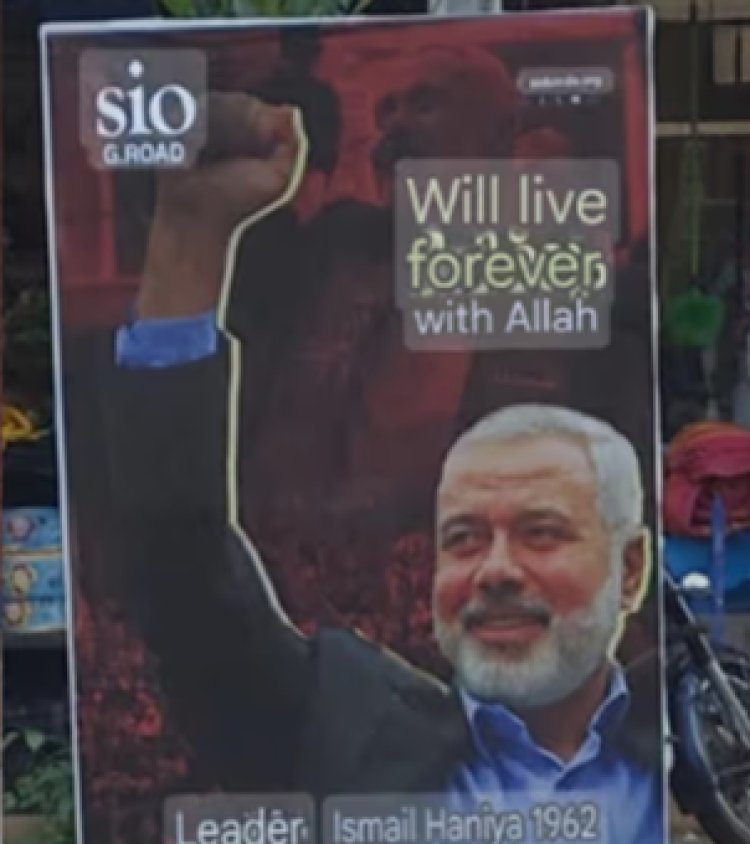
Source: X/Bala
Beyond virtual space, pro-Hamas sentiments have also surfaced in Kashmir. In one of the instances, during the Muharram procession in Srinagar in July 2024, anti‑Israel slogans were reportedly raised. In Kashmir, Hamas is not perceived as a political organisation but rather as a legitimate resistance movement, and this positions the group as an independent defender of Al-Aqsa. In propaganda messaging, which emerges particularly during the conflicts, Kashmir and Palestine are portrayed as “sister” resistance movements. These false claims legitimise Hamas violence in local eyes and help in portraying Palestine and Kashmir as part of the same struggle. In addition to this, Hezbollah, a Lebanon-based terror organisation enjoys the sympathy of Shia Muslims in Kashmir. In September 2024, following the death of Hezbollah leader Hassan Nasrallah, countless men and women participated in the protests, carrying banners denouncing Israel and the US.
These developments in India are increasingly worrying. The non-designation of Hamas and Hezbollah as terrorist organisations allows the network of sympathizers to organize rallies and campaigns, which increasingly feature slogans glorifying the terrorists, and this regulatory gap enables them to circumvent the legal measures. Over time, these events not only normalise the extremist narratives but also facilitate the recruitment, especially of youth, into Hamas and Hezbollah-aligned support networks.
The external influence: From BDS to Samidoun Palestinian Prisoner Solidarity Network
Groups such as Boycott Disinvestment and Sanctions in India and Indian People in Solidarity with Palestine (IPSP) widely protest against Israel and call for a boycott against companies supporting Israel. Their social media posts frequently equate Zionism with Hindutva fascism through slogans like “Down with Hindutva, Down with Zionism’’. Some of their campaigns blur the line between legitimate protest and extremist support. To be noted, boycott campaigns against the Israeli entity and its supporting companies are one of the central strategies of Hamas as mentioned in its document titled, ‘’Our Narrative.. Al-Aqsa Flood." In addition to this, between 2007 and 2017, Muslim Brotherhood-linked networks played a key role in establishing the campus-based infrastructure of political Islam through the Boycott, Divestment, and Sanctions (BDS) movement.
Another network requiring close monitoring is the Samidoun Palestinian Prisoner Solidarity Network. Established in 2011, it presents itself as a humanitarian campaign for Palestinian prisoners but has been designated by the U.S. and Canada as a sham charity that funnels funds to the Popular Front for the Liberation of Palestine (PFLP), a designated terrorist organisation. The PFLP has been active in the October 7 attacks and remains a key armed faction in the Israeli‑Palestinian conflict. Samidoun has also actively expressed its opinion on India’s internal matters , supporting campaigns against the Citizenship Amendment Act (CAA) and National Registration of Citizens (NRC), framing the Indian government as “fascist/hyper-nationalist,” and backing the so-called “Renaissance of India” movement while condemning alleged state violence at Jamia Milia Islamia (JMI), Aligarh Muslim University (AMU), and Jawaharlal Nehru University (JNU).
Malaysia: A Southeast Asian Hamas Front
Hamas links extend further into Southeast Asia, with Malaysia emerging as a key node. Since its independence in 1957, Malaysia has consistently supported Palestine and was the first Southeast Asian nation to grant full diplomatic status to the Palestine Liberation Organisation (PLO). To begin with, at the political level, following the October 7attack, Malaysian Prime Minister Anwar Ibrahim, in a conversation with Hamas leader Ismail Haniyeh, expressed strong support for the Palestinian cause. Even Hamas political bureau member Khalil al-Hayya publicly praised Malaysian PM Ibrahim.
Following Malaysian Prime Minister Najib Razak’s 2013 visit to Gaza, Hamas leader Khaled Meshaal, in his speech to the International Islamic University Malaysia (said to be
a part of the Global Muslim Brotherhood network), framed “Palestinian resistance” as legitimate.
Adding to this, operational-level linkages were reported in 2014, when an IDF-captured Hamas commander revealed that he received training in Malaysia on the use of motor-powered hang gliders, a tactic that was used during the October 7, 2023, attack. In 2015, Wasim Rashad Umran Qawasmeh, a Hamas recruit, was reportedly radicalised and recruited while studying at the International Islamic University Malaysia and received funds from Hamas operatives. Operational linkages became even more evident in 2018 with the killing of Fadi al-Batsh, a Kuala Lumpur-based Palestinian electrical engineer, who was reportedly involved in developing Hamas’s rocket and drone capabilities. Furthermore, Hamas leader Khaled Meshaal, with his delegation headed by Mousa Abu Marzook, head of the polit-bureau, attended the 2019 Islamic summit in Kuala Lumpur. Beyond this, Hamas has also reportedly used the Palestinian Cultural Organisation Malaysia (PCOM), which is described locally as an “unofficial embassy” for outreach and fundraising. These developments suggest that for years, Hamas has used Malaysia to facilitate its operational and ideological linkages, which remain to be monitored more seriously.
Way Forward:
With this background, the convergence between Hamas and Pakistan could heighten India’s security anxieties. Pakistan may serve as both an operational and ideological node, while Hamas, having expertise in tunnel-centric warfare and gliders, could offer tactical knowledge and training to the terror outfits in return, which could be replicated in future attacks. This was evident during the Pahalgam Attack in 2025, carried out by The Resistance Front (TRF), a proxy of the Pakistan-based terror organisation Lashkar-e-Taiba (LeT), which emulated Hamas-styled tactics. The transfer of tactical knowledge is worrying in the light of reports noting that in an event organised by Jaish-e-Mohammed (JeM) in the Mirpur District of POK in November 2025, in the presence of JeM senior commander Masood Ilyas Kashmiri, speakers at the gathering emphasised drawing inspiration from Hamas tactics. Jaish-e-Mohammed (JeM) is also exploiting the Gaza crisis for its terror‑financing activities, and a recent open‑source intelligence reported about JeM member claimed the group’s contribution of 1.5 billion rupees to Gaza. Analysts believe that this is used to legitimise and mask the diversion of funds into JeM’s own terror infrastructure. Moreover, Pakistan Senator Mushahid Hussain, in his recent interview, openly admitted that Palestinian fighters, including those from Hamas, are being trained in Pakistan. Moreover, Pakistan supports an international peacekeeping force in Gaza, but it wouldn’t deploy its troops to disarm or de-weaponize Hamas. The role of Qatar, Iran and Turkey in facilitating Hamas’s operations and finances via state‑linked institutions, charities and informal networks should be one of the core components of the counter-terrorism strategy.
It would be unwise to neglect Hamas military strength. Its military wing, Izzedine al-Qassam Brigades, maintains a formal military corps, including artillery, infantry, armour, air‑defence units, and conducts structured combat exercises and tunnel‑based missile operations. The use of advanced rocket and drone systems, and hang‑glider‑style infiltration, points to a level of technical sophistication.

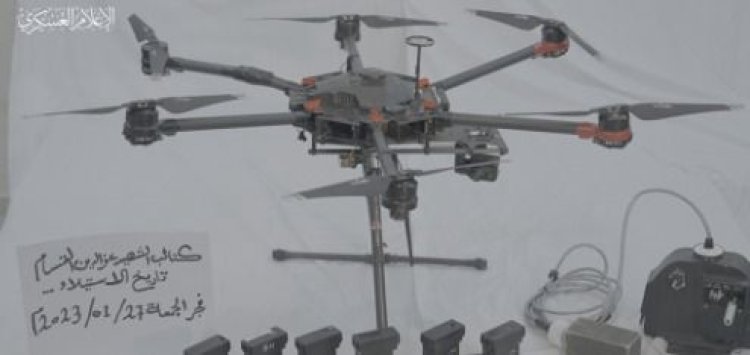
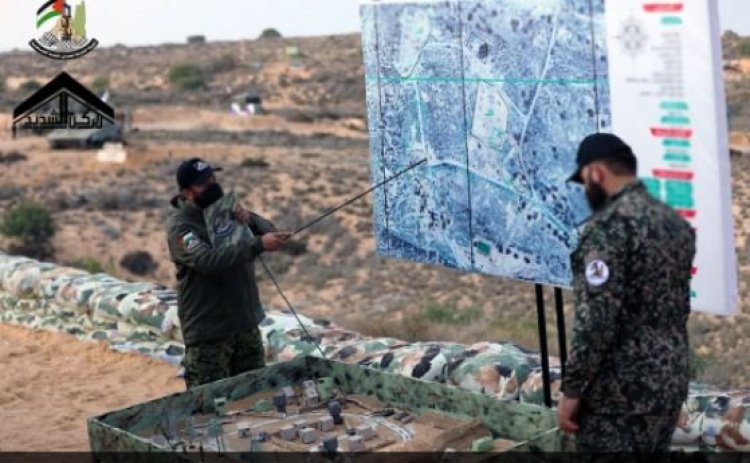
Source: al-Qassam/Fig. 1 A Hovercraft | Fig.2 An image from Extreme Corner Manoeuvre-2 exercise
This underscores that it is not merely a guerrilla movement but a well‑equipped and trained force. Within the interconnected jihadist ecosystem of South Asia, involving Lashkar‑e‑Taiba, Jaish‑e‑Mohammed and the transnational Jamaat‑e‑Islami network, this transfer of Hamas‑style tactics, training, operational doctrine and powerful narratives centred around Al-Aqsa Mosque could accelerate radicalisation and pro‑Hamas sympathies not only in Kashmir, where Hamas‑linked symbolism has already appeared, but also in the Indian hinterland. Moreover, the coordination between ISI‑backed modules and Malaysia‑based operatives in grenade‑attack plots last year is a visible sign of the exchange of tactics aimed at destabilising India. Given Malaysia’s assertive stance in maintaining ties with Hamas, this node must be carefully scrutinized and integrated into India’s counter‑terrorism and counter‑narrative strategy.
In policy terms, along with a sustained counter strategy, close monitoring of the transnational solidarity networks is required by counter-terrorism experts to disrupt mobilization around key symbolic dates such as February 5 (Kashmir Solidarity Day; observed annually in Pakistan), March 13 (Al-Quds Day), April 17 (Palestinian Prisoners Day) August 5 (Kashmir Exploitation Day/Youm-e-Istehal; observed annually in Pakistan), October 7 (Operation Toofan-e-Aqsa), and other major Kashmir and Al‑Aqsa‑linked symbolic events.
Moreover, Pakistan’s continued efforts to internationalise Kashmir and hyphenate with Palestine feed local radicalization in Kashmir and among Islamist networks in India. The moral-narrative-based branding strategy could normalise sympathetic attitudes toward violent tactics employed by Hamas and other Pakistan-based terror groups in the name of resistance, making jihadist narratives harder to counter, particularly in the online space. This narrative warfare constitutes a long-term radicalisation threat vector, accelerating pro-Hamas sympathies, not only in Kashmir but also in India’s hinterland. India must treat this trans-regional nexus as a serious long-term security challenge and formally designate Hamas as a terrorist organisation.
Disclaimer: This paper is the author's individual scholastic contribution and does not necessarily reflect the organization's viewpoint.