What do Bangladesh Election Outcomes Mean for India?
 usanasfoundation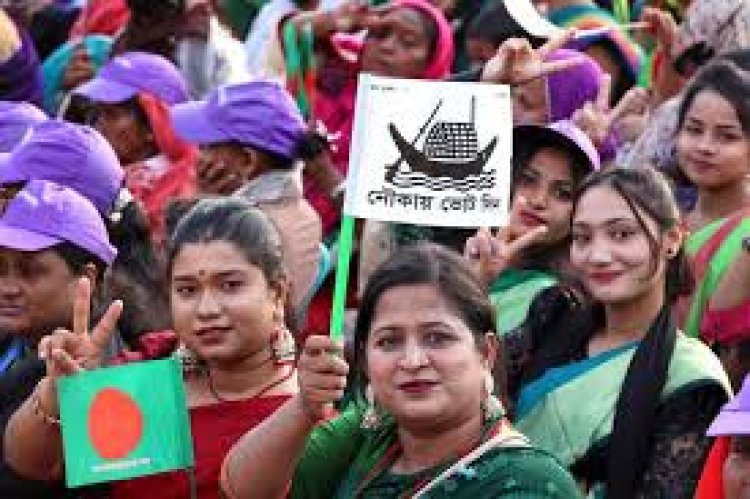
Analysis
By Dr. Abhinav Pandya
After a year and a half of uncertainty following the forceful ouster of Sheikh Hasina in an orchestrated coup, Bangladesh finally held its 13th national elections for the 300 seats of its Jatiya Sangsad. The Bangladesh Nationalist Party, Awami League’s main political opponent, has emerged as the single-largest party, defeating the Islamist hardliner Jamaat-i-Islami. It won 209 seats, securing a 2/3rds majority. Notably, the Jamaat-i-Islami’s moderate veneer, the newly formed student-led party, the National Citizen Party (NCP), one of the lead actors in the anti-Hasina protests, barely managed to secure six seats, despite strong financial backing from Pakistan. It simply shows that people rejected Hasina for her autocratic ways and chose BNP, another conventional democratic party, instead of the Islamist Jamaat-led alliance.
After Hasina’s ouster, a mere glimpse of Dhaka’s socio-cultural and political trends, administrative decisions and diplomatic shifts is enough to demonstrate that the nation that got freedom from the clutches of Islamist Pakistan to begin a secular journey is in a mission mode to undo the spirit and substance of the 1971 war of independence. India has been at the receiving end of Bangladesh’s new internal and external trajectory. Intense anti-India sentiments and rhetoric and Islamist revivalism form the dominant core of the mainstream social, cultural, and political discourse of India’s eastern neighbour. In post-Hasina Bangladesh, anti-India rhetoric and growing Islamism manifested in a spate of minority murders and mob lynchings, unprecedented expansion of Pakistan’s proxy Jamaat-i-Islami, hateful anti-India outpourings on social media, in social, political, and religious mobilisation and policy circles. Further, more virulent manifestations included verbal threats to cut off India’s vulnerable chicken-neck corridor and the release of maps showing Greater Bangladesh, appropriating India’s northeastern states.
Additionally, Dhaka’s worsening ties with New Delhi, at the expense of warming relations with Pakistan, Turkey, and China, disrupt India’s strategic calculus in a major way. Further, Pakistan and Turkey’s growing inroads leading to the strengthening of anti-India Jihadi terror groups such as Jamaat-ul-Mujahiddin Bangladesh, Ansarullah Bangla, Lashkar, ARSA, etc., in collusion with India’s north eastern insurgent groups, finding safe havens in Bangladesh, make for an alarming security situation in India’s North East. India’s security agencies’ reports confirm that Bangladesh-based terrorist groups have already increased their subversive activities in India’s north-eastern states. To sum up, the emergence of post-Hasina Bangladesh as New Delhi’s rival has turned India’s 2.5 threat into a 3.5 threat.
Bangladesh Election Outcomes: March Towards Islamism
Against this backdrop of India’s growing unease with the Islamists’ strengthening and anti-India state and nonstate actors in Bangladesh, these elections merit a detailed analysis in terms of their impact on India.
First and foremost, BNP’s victory offers a temporary solace. During the post-Hasina turmoil, India’s security establishment considered a myriad of ways to address the Bangladesh crisis. Amidst Modi’s hyper-nationalist army of supporters, YouTubers and influencers suggesting a robust military action to broaden the narrow chicken-neck corridor, the strategic gateway that connects India to its North East, the dominant line of thought in the foreign service bureaucracy has been to engage with the multiple stakeholders in Bangladesh. Among the bad options, India’s security elites perceive BNP as the best bet and Jamaat as the worst alternative. India expects the BNP government to be rational, realistic, pragmatic, and receptive to constructive engagement, mindful of the historical and civilisational ties with New Delhi, and focused on strengthening economic, investment, and connectivity partnerships. However, New Delhi’s most important concern is growing Islamism, anti-India sentiment, the strengthening of Jihadist groups and the increasing influence of China, Pakistan, Turkey, and the Western deep-state. Despite its frictional past with BNP, New Delhi, which has nurtured high hopes for the BNP, believes that Tariq Rahman’s government will bring down anti-India rhetoric and keep Islamists in check. However, a look at BNP’s history does not give an encouraging picture. Although in the recent election the BNP and Jamaat were rivals, in the past they were coalition partners. During the BNP governments in the early 1990s and 2000s, Pakistan-backed jihadists made strong inroads in Bangladesh. Bangladesh became a preferred route for Pakistan-backed Jihadists to infiltrate into India. Some of the hardcore terror masterminds, like Sajjad Afghani, a commander of Harkat-ul-Mujahiddin, and Maulana Masood Azhar, the mastermind of the Pulwama fidayeen attack, which brought India and Pakistan to the verge of a full-fledged war, infiltrated India through Bangladesh. Most recently, Humayun Kabir, the foreign policy advisor to Bangladesh’s PM Tariq Rahman, has not displayed a very reassuring tone in his message to India. The tone and tenor reflect BNP’s disdain for India’s warm ties with the ousted PM Sheikh Hasina. He stated that the Awami League worked under New Delhi’s influence as a subordinate, not on equal terms; however, the BNP puts Dhaka’s interest first and wishes to engage India on equal terms.
Along with the ongoing disputes over the water sharing of the Teesta River, India’s sheltering of the ousted PM Sheikh Hasina remains the biggest obstacle. Tariq Rahman’s foreign policy advisor, Humayun Kabir, has labelled her a terrorist. Both countries have an extradition treaty. The BNP government will try to pressure India to extradite Sheikh Hasina, but New Delhi is unlikely to comply. Even if Tariq Rahman is wise enough to ensure that long-standing bilateral ties between Dhaka and Delhi remain immune to frictions over temporary and personal issues loaded with optics and rhetoric, it will be challenging for him, given widespread anti-India and anti-Awami League sentiment in Bangladesh.
Secondly, the foreign players in Bangladesh are too strong to let BNP slip into India’s fold and disrupt their geostrategic ambitions. In the backdrop of growing India-Pakistan tensions, the Pakistan army views Bangladesh as a reversal of the humiliating defeat of 1971, and a leverage to hurt India in its Achilles’ heel, i.e. its North East. For Turkey, India’s another adversary and Pakistan’s ally, the lucrative defence partnership with Dhaka is too important to be squandered away. For China, India’s receding influence in the Bay of Bengal region after Hasina’s ouster is the most desirable geopolitical development. The West also has its own geostrategic interests, including the creation of military bases in the region, which hardly align with India’s interests. That said, these foreign interests are too powerful to allow the BNP to have a decisive say in the country’s geostrategic and geoeconomic trajectory.
In all likelihood, BNP will be subsumed into the ambitions of global geostrategic players. More disturbingly, most of them do not have their interests in a mutually exclusive situation, barring some exceptions. For example, Turkey, Pakistan, and Qatar are bound together by Islamism. China works in tandem with Pakistan to curb India’s influence. Under Trump, the India-US ties have reached a new nadir. On the other side, Trump has a far better personal equation with Pakistan’s de facto chief, Field Marshall Asim Muneer and Turkey’s Islamist President Erdogan. On the other side, India’s geostrategic interests are at odds with the deepening presence of an array of adversarial foreign powers. Amid such geopolitical giants, India has little leverage, and BNP is not strong enough to play an independent and decisive role. Further, India’s bitter history with BNP and the widespread anti-India sentiment in society make it even more difficult for BNP to achieve a breakthrough with India, even if it desires to. However, if good sense prevails in Tariq Rahman’s core team, realising the civilisational bond between India and Bangladesh and India’s inevitability and indispensability, and if it sincerely desires to normalise and better bilateral ties with India, Rahman will have to prove himself a fine negotiator and a juggler with extraordinary skills to balance between India and the vast array of powerful foreign players, discussed above.
Disclaimer: This paper is the author's individual scholastic contribution and does not necessarily reflect the organization's viewpoint.
Dr. Abhinav Pandya is the Founder and CEO of Usanas Foundation