From Diplomacy to Partnership: Modi’s Visit to Israel
 usanasfoundation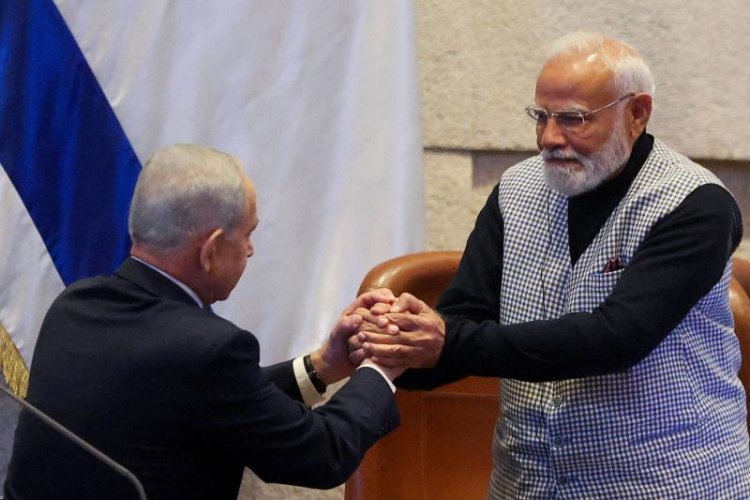
Analysis
By Dr. Abhinav Pandya
India’s Prime Minister Narendra Modi made his second visit to Israel in February 2026, six years after his first visit, which was also the first visit of any Indian PM to Israel. Modi received a warm welcome in Israel. His counterpart, Netanyahu, said, “You are more than a friend.” Standing ovations followed his Knesset speech, and Israeli parliamentarians enthusiastically clicked selfies with him.
The historic visit has led to the signing of 17 Memorandums of Understanding, agreements, and implementation protocols, boosting trade, economics, defence, agriculture, technology, culture, intelligence, and education ties, while also strengthening Fintech cooperation, labor mobility, and strategic planning. The most important outcome was the mutual decision to upgrade the bilateral relationship, which began in 1982 and grew deeper after 2014 under the Modi government, to a Special Strategic Partnership, marking a new chapter in bilateral relations.
Though India-Israel defence partnership has strengthened since 2014, India’s official stance on the Palestinian issue has not been one of unequivocal support for Israel. Under the influence of India’s powerful foreign service bureaucracy, ridden with Cold War ideological remnants, a flawed understanding of India’s security and strategic interests, and Islamist ideological and financial influences within its ranks, Modi’s Hindu-nationalist government largely continued India’s traditional policy with a conspicuous anti-Israel tilt on the Israel-Palestine conflict. New Delhi has not yet designated Hamas a terrorist organisation, despite substantial evidence of its growing links with Lashkar-e-Taiba, a Pakistan-supported terrorist group active in Kashmir. Generally, India abstains from voting at the UN on Israel-Palestine issues. Most recently, in January 2026, India joined China and Pakistan in voting against the United Nations’ resolution condemning Iran for its crackdown on peaceful protesters.
India’s Hindu nationalist supporters passionately support Israel’s resilience, courage, determination, and success against terrorism. The Modi government’s conservative stance and hesitance to drastically change India’s Israel policy have disappointed them, weakening his tough public image as an anti-Islamist.
However, Modi’s visit to Israel at a time when the US-Israeli attack on Iran seemed imminent has marked a departure from India’s traditional neutral stance. In his Knesset address, PM Modi stated, "India stands with Israel, firmly, with full conviction, in this moment, and beyond……….." No cause can justify the murder of civilians. Nothing can justify terrorism. His statement leaves little doubt about India’s stance in the future. A large majority of Indian Muslims, already angry over Modi’s allegedly pro-Hindu and tough counter-terrorism policies, see Modi’s visit as a clear demonstration of support for Israel, just shy of a formal declaration.
This may have its consequences, leading to significant policy shifts. India might soon declare Hamas a terrorist organisation. Additionally, India may join Israel’s Hexagon Alliance initiative against extremist Islam, which includes Israel, Greece, and Cyprus, and is likely to involve many African and Asian countries. It is also important to note that these moves are not solely to address Israel’s concerns but also align with India’s security interests. Recently, Hamas has become a national security threat to India due to its increasing links with the Kashmir-based terrorist group Lashkar-e-Toiba, and the Hexagon Alliance could help counter the Turkey-Pakistan alliance. Although India, with its pusillanimous approach towards Turkey and its historical aversion to alliances, still finds it challenging to join formally, after Turkey’s active support to Pakistan during the brief India-Pakistan war in May 2025, New Delhi has limited options. Within the Hexagon Alliance, India gains an opportunity to encircle Turkey in the Mediterranean with Israel’s assistance. What more could it ask for?
Furthermore, Modi’s visit closely follows the India-European Union Free Trade Agreement. Free Trade Agreements with Canada and Israel are also under consideration. India has recently reached a trade deal with the US, bringing peace between the two countries. Apparently, after the short war with Pakistan in May 2025, New Delhi has internalised that only Israel remains India’s reliable, all-weather friend amid the ongoing geopolitical upheavals worldwide. Additionally, China’s support for Pakistan and Russia’s cautious stance due to its vulnerabilities to Beijing have made Delhi realise that its future lies with the Western camp, not with dictators, Islamists, and disruptors. Finally, the potential collapse of the Iranian regime could remove the last obstacle between New Delhi and Jerusalem.
Both the emotional symbolism and tangible results of this visit make it a pivotal event in India’s foreign policy, indicating that India has internally made its final choice, i.e., a decisive shift toward the West, although it is likely to avoid any formal statements.
Disclaimer: This paper is the author's individual scholastic contribution and does not necessarily reflect the organization's viewpoint.
Dr. Abhinav Pandya is the Founder and CEO of Usanas Foundation